
Google AI Overviews now appear across a large share of UK searches, sitting above the traditional results and pulling together an answer from several sources at once. If you run a business website, you’ve probably noticed it changing how people find you — sometimes helpfully, sometimes with a lot more uncertainty about where clicks are actually coming from. The reassuring part is that AI Overviews aren’t a separate ranking system with secret rules. They lean on the same index, the same quality signals and largely the same Search Engine Optimization fundamentals that have mattered for years. This guide covers what’s actually worth doing about it, and what isn’t.
Google AI Overviews SEO starts with understanding what you’re actually optimising for. AI Overviews are AI-generated summaries that appear near the top of the results page for certain searches, typically ones with an informational or exploratory intent. Rather than showing ten blue links and leaving you to click through each one, Google draws information from multiple webpages, synthesises it into a short answer, and links out to the sources it used.
That retrieval process — Google refers to it as retrieval-augmented generation, or RAG — relies on the same Search index and ranking systems used for standard organic results. There’s no separate ‘AI index’ running alongside it. Source citations matter here because they’re one of the main ways a business gets visibility inside an AI Overview: your brand or link appears as one of a handful of references the summary drew from, rather than as a ranked listing users scroll past.
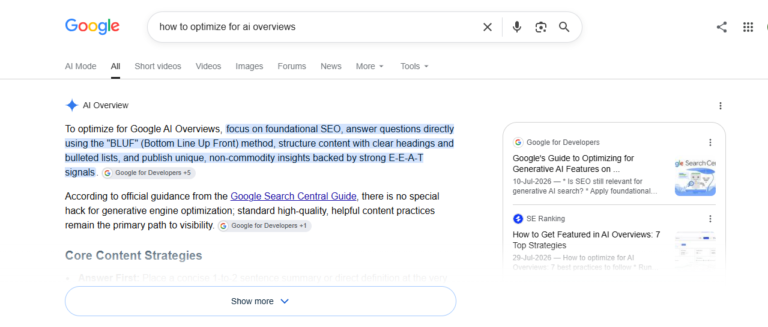
The honest answer is that AI Overviews change the shape of the results page more than they change what makes a page rank well in the first place. When an AI Overview appears, it typically sits above the organic listings, which can influence how many people click through to any individual result — though the scale of that effect varies considerably by query type, industry and search intent, and it’s worth being wary of anyone quoting one universal figure.
What matters practically is this: strong visibility in traditional organic search remains the foundation for AI Overview visibility. Google has said plainly that its generative AI search features are rooted in the same core ranking and quality systems as standard Search, so a page that doesn’t rank well organically is unlikely to earn an AI Overview citation either. AI search visibility and conventional SEO aren’t two separate disciplines — one feeds directly into the other.
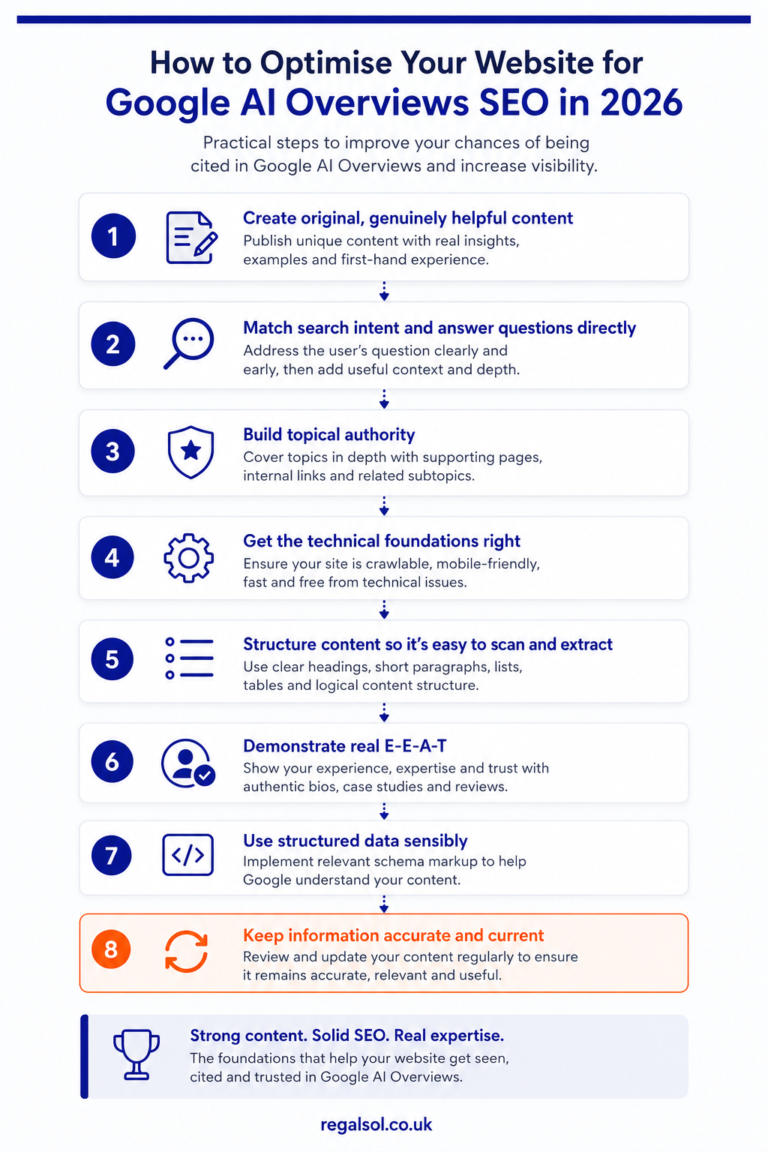
These are the areas worth focusing on, roughly in order of impact.
This is the biggest lever available. Google’s own guidance for generative AI features emphasises originality and information gain — content that adds something beyond what’s already ranking, rather than restating it in different words. If you run a joinery business or a flooring showroom, that might mean writing up a real installation problem you solved, with specifics, instead of a generic ‘benefits of new windows’ listicle that reads like every competitor’s.
AI Overviews tend to trigger on informational and conversational queries — the kind of question someone might type into a chat interface. Structure content to answer the core question early and directly, then expand with context and detail. Long-tail, question-based headings help both human readers skimming for an answer and systems trying to extract one.
A single strong page rarely earns citation on its own. Google’s systems assess how thoroughly a site covers a topic and the entities related to it. Supporting pages, sensible internal linking between them, and consistent coverage of related subtopics build the kind of topical depth that signals real expertise rather than a one-off blog post.
None of the above matters if Google can’t crawl and index your pages properly. Check Google Search Console regularly for crawl and indexing issues, keep the site mobile-friendly, and pay attention to Core Web Vitals and overall page experience. These aren’t new requirements invented for AI search — they’re the same technical SEO basics that have underpinned good rankings for years.
Descriptive H2 and H3 headings, short paragraphs, bullet points, tables and clear definitions all make a page easier to parse — for readers and for retrieval systems alike. A logical hierarchy, where each section answers one clear question, tends to hold up better than a wall of text trying to cover everything at once.
Experience, expertise, authoritativeness and trust remain central to how Google evaluates sources. For a small business, that might mean an author bio with genuine credentials, case studies with specifics rather than vague claims, visibly authentic customer reviews, and an About page that explains who’s actually behind the business. First-hand experience — ‘we did this, here’s what happened’ — is harder to fake and carries more weight than generic advice.
Schema markup helps Google understand what a page is about and can support rich results, but it doesn’t guarantee AI Overview inclusion — Google’s own documentation is clear that there’s no special schema requirement for generative AI features. Use structured data because it’s good technical practice, not as a shortcut to AI visibility.
AI Overviews favour fresh, accurate information, particularly on fast-changing topics. Review key pages periodically, update statistics and examples, and correct anything that’s gone out of date. A page that was accurate a couple of years ago but hasn’t been touched since is a weaker candidate for citation than one that’s genuinely kept current.
Traditional Google Search vs Google AI Overviews — what’s changed, and what hasn’t.
Traditional Google Search | Google AI Overviews |
A list of organic listings for the user to compare | A single synthesised answer drawn from several sources |
User reviews multiple results and decides which to click | User reads one summary, with linked sources for more detail |
Ranking position is the main visibility signal | Being cited as a source is the main visibility signal |
Meta titles and descriptions strongly influence click-through | Clarity, directness and topic coverage influence citation |
Keyword matching and search intent both matter | Topic coverage and directly answering the query matter more than exact keyword matching |
SEO fundamentals — technical health, content quality, E-E-A-T | Same SEO fundamentals, with AI Overviews as an additional layer on top |
There’s no special trick that guarantees a spot in a Google AI Overview, and anyone promising one is overselling it. What actually helps is the same work that’s always underpinned good search visibility — useful content, a technically sound website, and clear signals of real expertise — applied with AI search in mind rather than as an afterthought.
If you’d like a second opinion on where your website currently stands, RegalSol‘s SEO team can review your technical setup, content and search visibility, and suggest a practical plan for strengthening it. Get in touch to talk it through. Contact us now!
In principle, yes — but in practice, sites with weak organic visibility are rarely cited, since AI Overviews draw from the same index and ranking systems as standard search results.
Yes. Google has said explicitly that its generative AI search features are built on the same ranking and quality systems as traditional Search, so established SEO practices remain the foundation.
There’s no guaranteed method. Focus on original, well-structured content that clearly answers real questions, solid technical SEO, and demonstrable E-E-A-T — the same things that support strong organic rankings generally.
It can help Google understand your content, but it doesn’t guarantee inclusion. Google’s own guidance confirms there’s no special schema requirement for generative AI search features.
AI Mode is a more conversational, chat-style search experience, while AI Overviews are summaries shown within standard search results. Both draw on the same underlying Search systems and reward the same fundamentals.